

%20-%20Credit%20Patrick%20Fenner.jpg)
Rich Exner
Publication Date: May 13, 2026
Cleveland.com (link to original article)
CLEVELAND, Ohio — For decades, a manufacturing corridor stretching along a rail line south of Euclid Avenue through the Central and Fairfax neighborhoods has largely been known for what it lost.
Factories closed. Jobs disappeared. Buildings sat empty. Land that once helped power Cleveland’s manufacturing economy became fragmented into dozens of abandoned and contaminated parcels, many untouched for generations.
Now city leaders are betting that same corridor could become the centerpiece for job growth by attracting several businesses - triggered by a nearly complete massive land assemblage and early cleanup work for hundreds of acres.
Mayor Justin Bibb and a city-created nonprofit called the Site Readiness for Good Jobs Fund on Wednesday unveiled “The Midline” - an initiative aimed at transforming the large swath of land into a new employment district for manufacturing, research and development, food production and other industries.
In what could be considered stunning speed, considering the complexities involved in assembling real estate from a patchwork of owners, the Site Readiness group says it has acquired roughly 200 acres for the Midline in less than three years after its founding.
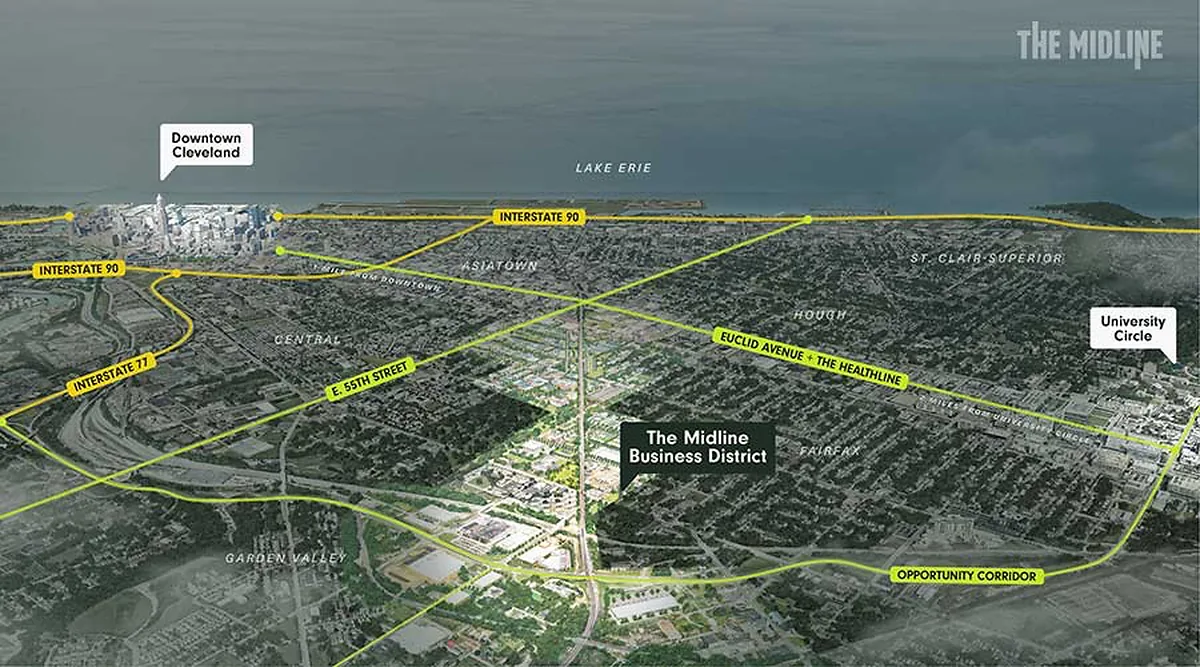
Counting existing businesses, such as Pierre’s Ice Cream, Orlando Baking and Miceli Dairy Products, the Midline zone actually includes more than 350 acres - running southeast from Euclid Avenue and East 55th Street to the Opportunity Corridor roadway.
“The Midline is the most ambitious redevelopment project, I believe, in modern history in Cleveland,” Bibb said during an interview ahead of the announcement.
“We are looking to really put to work 350 acres of land right in the middle between the Midtown health tech corridor and the Opportunity Corridor; 200 of those acres will be redeveloped for shovel-ready job sites.”
Site Readiness Fund officials said they are in talks with multiple businesses about locating in the zone, but don’t have any deals to announce.
Yet they believe the work that has already taken place will lead to the first deals later this year.
The fund has spent about $10 million on acquisition, environmental testing and demolition in the Midline area, officials said. Over the next several years, it is expected to cost up to $100 million to prepare the entire Midline site for future development, officials said.
The district sits between two of the city’s major transportation investments — Euclid Avenue’s Health Line corridor and the Opportunity Corridor — with easy connections to interstate highways, and access for workers to the bus rapid transit line and two commuter rail stations. Bibb hopes some people will be able to walk to work.
“My grandparents came here from Alabama and Georgia to work in the auto plants, work in the steel mills,” Bibb said. “We want to make Cleveland a walk-to-work city once again.”
The goal is to create at least 1.5 million square feet of new industrial and commercial space and eventually support more than 2,500 jobs.
Federal stimulus money
The Midline is the biggest single project as part of a larger effort launched in 2023, when the city committed $50 million in federal stimulus money to create the Site Readiness for Good Jobs Fund. The Cleveland Foundation contributed another $10 million.
Thanks in part to investment returns, about $50 million still remains in the fund, officials said. Their work also has received support from the Ohio Department of Development, JobsOhio, the U.S. Department of Transportation, the U.S. Department of Commerce, EPA and others.
Bibb said Cleveland’s lack of large, “shovel-ready” industrial sites had become a recurring obstacle in economic development discussions.
Companies interested in expanding within Cleveland, particularly manufacturers, often could not find sites large enough to meet their needs, he said, pushing investment to suburbs such as Solon, Strongsville, Hudson and Bedford.
“The market right now wants something generally 10 acres or more,” said Brad Whitehead, managing director of the Site Readiness for Good Jobs Fund. “But in a legacy industrial city, it’s often 2 acres here, 3 acres there. Incredible fragmentation.”
Now, he said, Cleveland can offer the larger sites.
Many of the properties came with environmental problems, deteriorated buildings or decades of neglect.
“When you think of the Rust Belt, this is the photograph you think of,” Whitehead said. “It’s Exhibit A in industrial decay.”
Still, officials said the location offers unusual advantages: just over 2 miles from both downtown to the west and University Circle to the east, with freight rail access and interstate highway connections nearby.
The nonprofit acquired the Midline parcels through a mix of purchases, sheriff’s sales, donations and partnerships with the Cuyahoga Land Bank.
This effort intentionally was kept largely under the radar, because the site fund did not want to tip off absentee property owners who may then “jack up their prices,” said Sara Jex, project manager for the Site Readiness for Good Jobs Fund.
Jex said just a few smaller parcels are yet to be purchased.
The parcels, though now often listed in property records as being held by the county land bank, are actually owned by the site fund under trustee agreements, Whitehead said.
Some cleanup work is underway or scheduled to begin soon at sites including the former U.S. Sugar Co. that closed last year, portions of the long vacant building at 7000 Central Avenue that was once home to a Hulett factory, and other spaces along Ashland Road and East 79th Street.
The nonprofit has received brownfield cleanup grants and additional federal planning support tied to transportation and workforce development programs.
Officials estimate fully preparing Cleveland’s vacant industrial land citywide could ultimately cost billions, which means the goal of the nonprofit work is to set the stage for private development with the help of others like the Cleveland Foundation.
“Government can’t do it all,” Bibb said.
Broader neighborhood goals
The Midline is being designed as a long-term urban district that combines jobs with public amenities.
Plans include a greenway and trail system running roughly along the Norfolk Southern rail corridor, intended to improve pedestrian and bicycle connections while adding parks, trees and open space to heavily industrialized neighborhoods.
The idea partially grew from planning work by Cornell University students who identified the corridor as a major gap in Cleveland’s pedestrian and bike network.
LAND studio CEO Keisha Gonzalez said the project also aims to address long-standing environmental and health burdens in surrounding neighborhoods.
“Our goal is to reduce those health impacts through cleanup and bring in green space that gives residents cleaner air, more nature, and a better everyday environment,” Gonzalez said.
The city and the Site Readiness Fund are targeting employers that provide higher-paying, production-oriented jobs accessible to Cleveland residents.
Orlando Grant, who oversees community engagement and strategy development for the nonprofit, said the organization is especially focused on companies offering wages of $25 to $30 an hour.
The group is also exploring models that could allow residents to invest in or partially own businesses locating in the district, though officials said those ideas remain in early stages.
Traditional business attraction could come sooner.
Whitehead described the project as being “in the red zone” - a football term for when a team is within 20 yards of scoring a touchdown. He said he anticipates being able to make announcements with companies this summer or fall.
“We’re open for business,” he said. “We’re starting to build the pipeline.”